OPERATING STATESubstrate · productionRoutes · 12Tests · 1,340+Human end-gate · armedAuto-publish · off until calibrated
Notes / Showcase A — the operator-substrate
One human. One AI. A company that runs.
Attesté is a SaaS company operated day-to-day by a single person and an AI agent on a custom-fit
Substrate. This is a guided flight through its actual cockpit — every screenshot below is the
production system, not a mock.
Published 29 Apr 2026 · Updated 6 Aug 2026 · Operator: Charl le Roux · Substrate v3.x · Domain: atteste.art · Artifacts: production, contacts redacted
The thesis: one person can run a company — if every consequential action passes a gate a human can trust.
The Command Centre is a local desktop application. It runs on the operator's own machine, was never
deployed to the public internet, and keeps its credentials in an encrypted local store. The substrate
stays home. What follows tours its four wings: Studio, Growth, Intelligence, System.
№ 01 · Studio
A post is born constrained.
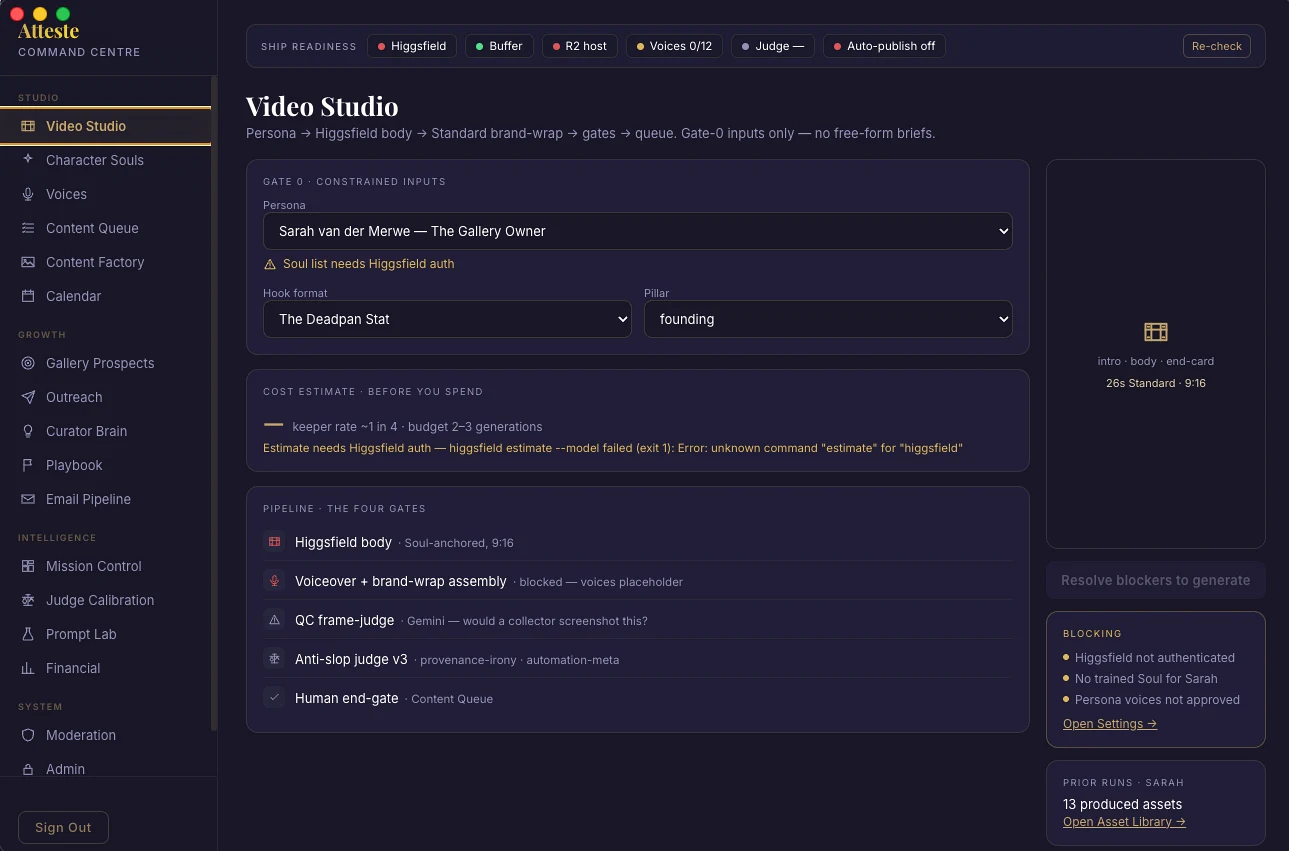
The Video Studio accepts a persona, a hook format and a content pillar — there are no
free-form briefs, because free-form briefs are how a brand voice dies. The blockers
panel refuses to generate until authentication, trained identity models and approved voices
exist. Fail closed, not open.
command-centre · video-studio№ 02 · Studio
Four gates stand between a draft and the world.
A Soul-anchored video body. Voiceover and brand-wrap assembly. A vision model interrogating the
stills — would a collector screenshot this? Then the anti-slop judge. Whatever survives
still lands in the Content Queue for a human to approve, and only then schedules
out to the calendar.
№ 03 · Studio
The cost is on the table before a rand is spent.
Every run shows its estimate and its expected keeper rate — roughly one keeper in four, budgeted
at two to three generations. An operator who can see the cost of taste can afford to have it.
№ 04 · Intelligence
The judge earns authority; it isn't granted.
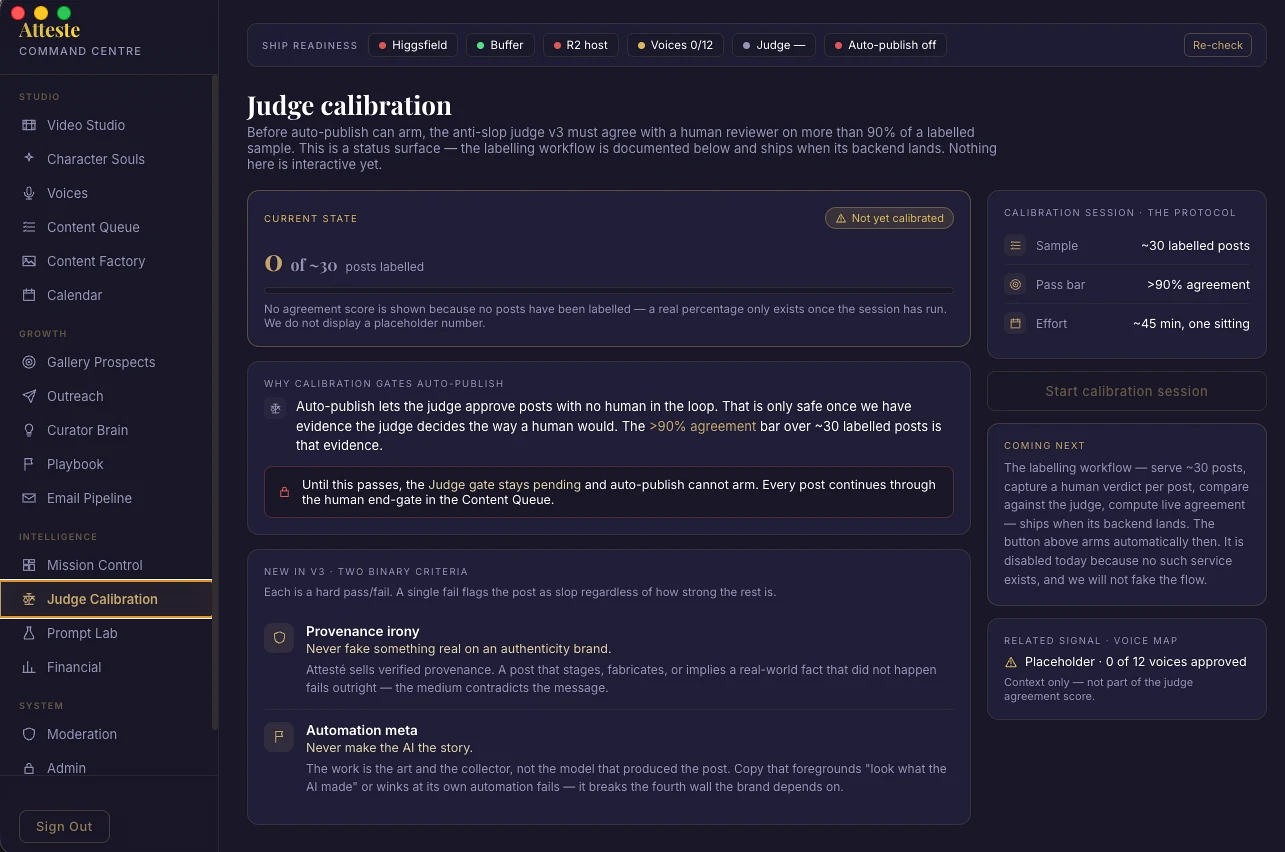
Auto-publish stays disarmed until the anti-slop judge agrees with a human reviewer on
more than 90% of ~30 labelled posts. The calibration screen shows zero posts
labelled and no agreement score — because none has been earned yet, and the system refuses to
display a placeholder number.
Provenance irony — never fake something real on an authenticity brand; a staged
"real-world" moment fails outright because the medium would contradict the message.
Automation meta — never make the AI the story; copy that winks at its own
automation breaks the fourth wall the brand depends on.
№ 06 · Consent
Some buttons are missing on purpose.
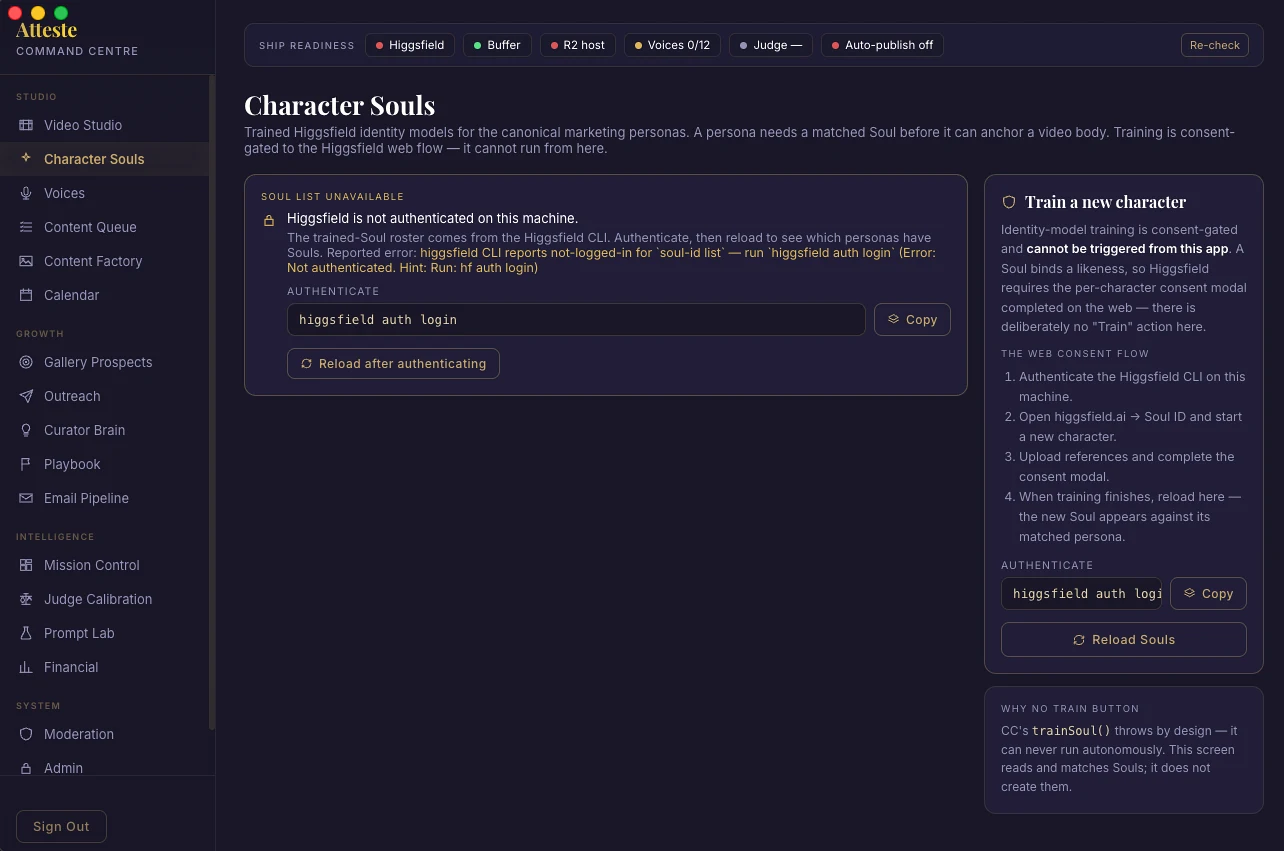
The personas are trained identity models — a Soul binds a likeness, so training one
cannot be triggered from the cockpit at all; the train function throws by
design. The only path runs through the provider's per-character web consent flow, completed by
a person. The interface documents its own restraint.
command-centre · character-souls№ 07 · Growth
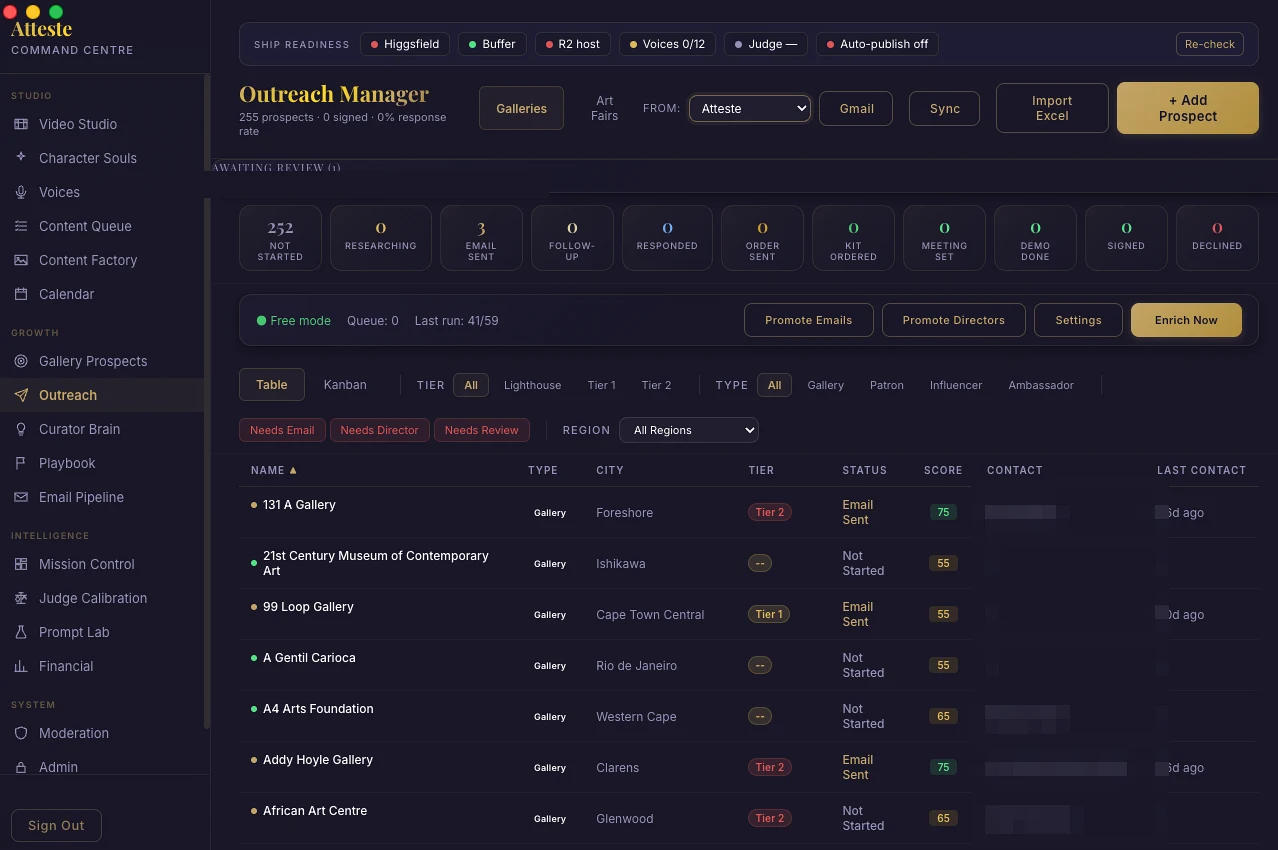
255 prospects, eleven stages, one pipeline.
From not started through research, first contact, follow-ups, sample kits and meetings
to signed. An enrichment scheduler works the backlog on a daily budget, scoring and
tiering every gallery; the strategist's Playbook turns scores into each morning's calls.
The principle that governs the studio governs growth: drafted emails land in an
awaiting-review queue, and a person presses send. AI speed where speed is
cheap; a human signature where a relationship is at stake.
"We do not display a placeholder number."
— the calibration screen, refusing to fake its own evidence
1+1human + AI agent
12cockpit routes
255gallery prospects
>90%judge agreement bar
11pipeline stages
1,340tests on the cockpit
§ The substrate underneath
None of this works on a generic model.
The cockpit is the visible tenth. Beneath it, the Substrate holds what the business actually knows —
structured, queryable, on hardware the operator controls.
The catalogue
Every artwork, artist, gallery and persona — relationships, not rows.
The pipeline
Every prospect and conversation, and where each sits in the buying journey.
Shipped, in-progress, deferred, killed — with the rationale kept.
§ The day, on rails
The operating loop
Each morning the loop runs again — slightly smarter than yesterday, because yesterday was captured.
01 · brief
The substrate reports
Overnight signals become a briefing: what changed, what needs a human, what's drifting.
02 · decide
The human reviews
Approve, modify or kill the proposed actions. Minutes, not meetings.
03 · execute
The substrate works
Everything that doesn't need a signature runs; drafts queue in the outbox.
04 · capture
The day is kept
Decisions, conversations and changes land back in the substrate.
§ Division of labour
AI speed. Human signatures.
The human signs
Compliance and material legal commitments
Strategic redirections — the data proposes, the human decides
Relationships that need a human voice
Anything irreversible
The substrate runs
Drafts nearly all outbound — to the outbox, never auto-sent
Reconciles the books against bank feeds, flags anomalies
Maintains the marketing pipeline end to end
Answers routine queries; hands off the rest
Surfaces decisions — never buries them
§ Why this is safe
Three gates make it boring, in the best way.
The audit log
Every command captured — append-only, hash-chained, on hardware the operator controls.
The credentials
The substrate refuses to type passwords or 2FA codes. Keys stay with the human.
The outbox
Destructive or outward actions queue for explicit approval. Nothing auto-fires.
§ The same pattern, your business
Could one person run yours?
The operator-substrate pattern fits any business whose day-to-day is information-handling:
services, advisory, software, content, finance. The diagnostic maps it to yours — plain
questions, fixed quote at the end.